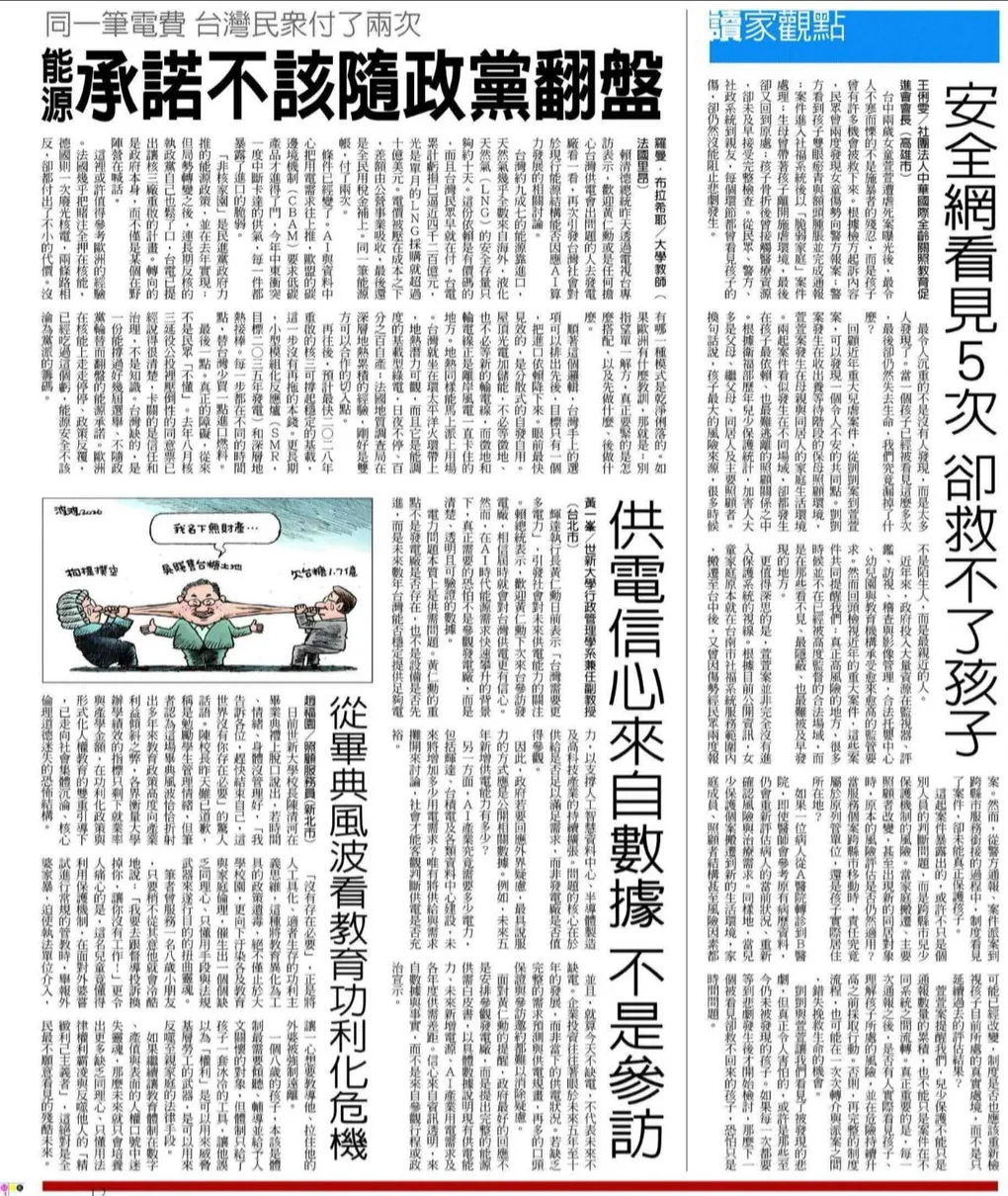
Energy Policy Should Not Switch Sides at Every Election (Taiwan) — 聯合報 (United Daily News)
I have an op-ed in the 聯合報 (United Daily News) — one of Taiwan’s major daily newspapers, on page A14 — about the island’s energy policy. My starting point is a simple question: why does Taiwan pay the same energy bill twice?
What is the 聯合報 (United Daily News)?
The 聯合報 (Lianhe Bao, United Daily News) is one of Taiwan’s historic newspapers. Founded in 1951, it is one of the island’s three major dailies, read by economic and political decision-makers. Publishing an op-ed there means speaking directly into Taiwan’s public debate, in the language of that debate.
A bill paid twice
The Taiwanese consumer pays for energy a first time through an artificially low electricity price. Then they pay for it a second time, in taxes, to cover the losses of the public utility that this subsidized price mechanically generates. The result is a cumulative deficit of roughly NT$420 billion — a deferred debt, not a sustainable subsidy.
To this financial fragility is added a physical one: Taiwan’s natural gas reserves cover only about ten days of consumption. For an island that imports nearly all of its energy and lives under the threat of a blockade, that is a dangerously thin safety margin.
The real problem is not technical — it is one of governance
That is the heart of my argument: Taiwan does not lack energy solutions — it lacks consistency. The real problem is not technology; it is that the island’s energy commitments change with every change of government. One majority launches a trajectory; the next dismantles it. No energy policy — which plays out over decades — can survive that stop-and-go cycle.
Europe has already paid this price, in opposite directions. France built its electrical independence on a nuclear fleet planned over the long term, then nearly squandered that advantage through successive hesitations. Germany, by phasing out nuclear power without a sufficient dispatchable substitute, found itself dependent on gas and exposed to the 2022 shock. Two bitter lessons, in opposite directions, but the same moral: an energy policy is only worth anything if it holds across several terms in office.
A sequenced trajectory
So what I propose is less a choice of technology than an order of march:
- Decentralized solar and storage first — what can be deployed quickly, close to consumption, easing the grid in the immediate term.
- Geothermal next — Taiwan sits on the Pacific Ring of Fire and holds there a dispatchable resource that remains largely untapped.
- Then restarting nuclear power and small modular reactors (SMRs) — for the decarbonized long-term baseload.
But none of these steps will hold without the essential ingredient: energy policies that survive changes of government, ring-fenced beyond the electoral calendar.
It is a Taiwanese debate. It is also a universal question.
→ Read the op-ed in the 聯合報 (United Daily News)
Photo: wind turbines off the coast of Taiwan.